
Sheet metal bending is a precise forming process where force is applied to a metal sheet to give it the desired angle and shape. While it may seem like simply bending a piece of metal, this process is backed by complex material science. The two most critical factors determining the quality, cost, and speed of manufacturing are the Material Thickness and the Material Type.
Correctly understanding and calculating these two fundamental dynamics is key to a successful, flawless, and low-waste manufacturing process.
1. The Critical Effect of Material Thickness (t) on Bending
Material thickness (commonly denoted as ‘t’) is the starting point for all mechanical calculations in the bending process. A change in thickness affects everything from the machine requirements to the final shape of the part.
1.1. Effect on Required Force (Tonnage)
The force (tonnage) required for bending increases exponentially with the thickness. This means that when you double the thickness of a sheet metal, the required force to bend it increases by more than double.
- Practical Outcome: This directly influences the choice of machinery (the capacity of the press brake). Incorrect tonnage calculation can damage the machine or prevent the bending process from being completed.
1.2. Minimum Bend Radius (RMin)
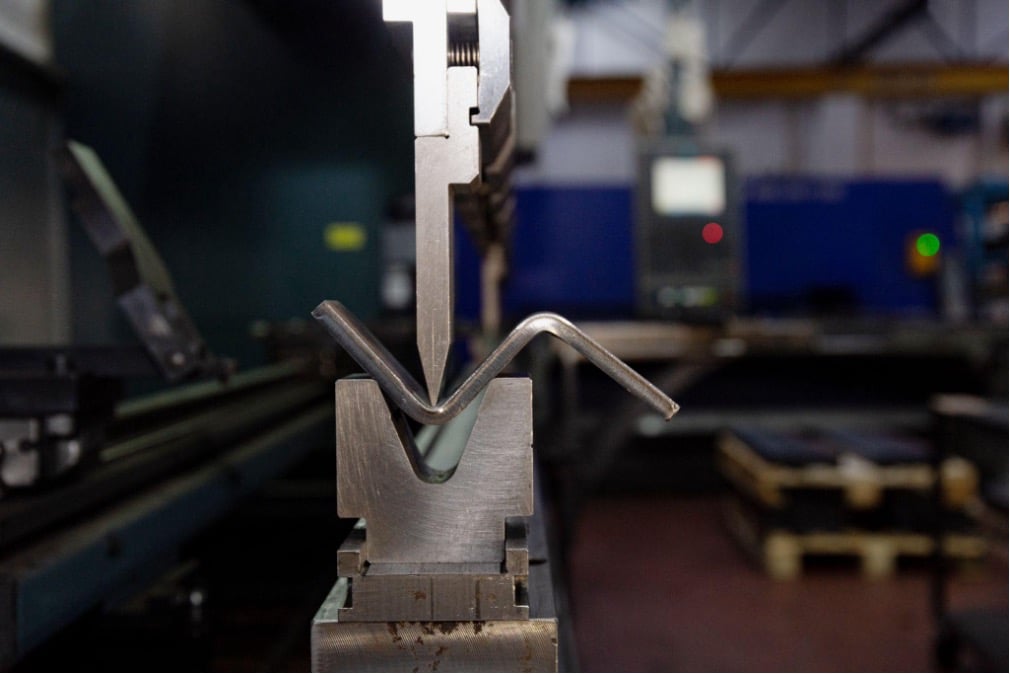
Every metal has a minimum inner radius at which it can be bent without cracking or tearing its outer surface. This radius (RMin) is directly related to the thickness. While not an absolute rule, for most metals, RMin should be equal to or slightly greater than the material thickness (t).
- Practical Outcome: Thicker material requires a larger inner radius. If a part is forced to bend to a sharp (small radius) angle, the material will tear, compromising the part’s integrity.
1.3. V-Die Opening Selection
One of the most important factors determining the bending quality and the inner radius is the width of the bottom die (the V-die opening). This V-opening is typically selected to be between 6 to 12 times the material thickness.
- Practical Outcome: Incorrect selection of the V-opening compromises the part’s bending quality and its final inner radius. This selection must be precise to ensure a uniform force distribution, resulting in a clean bend.

2. The Determining Factors of Material Type
The chemical composition and internal structure of the material directly influence its behavior during bending and the stability of the bend after the process.
2.1. Yield and Tensile Strength
- Definition: Yield Strength is the point of stress at which the material begins to deform permanently. Tensile Strength is the maximum stress the material can withstand before breaking.
- Effect: The higher these values are (e.g., in high-strength steels), the more force (tonnage) is required to push the material into the plastic deformation range. High-strength materials also subject the dies and the machine to greater wear and tear during bending.
2.2. Springback Behavior
This is one of the biggest challenges created by the material type in the bending process. Springback is the degree to which the material returns to its original shape due to its elasticity after the bending force is removed.
- Factors: Materials with high yield strength and a low modulus of elasticity (like some aluminum alloys) exhibit greater springback. This means that to achieve a 90-degree bend, the machine must over-bend the material (e.g., to 88 degrees) to compensate for the springback.
2.3. The Big Three: Bending Behavior of Common Materials
Material Type | Key Characteristics | Bending Difficulty | Springback Tendency |
Carbon Steel (Mild Steel) | High toughness, relatively easy to process. | Medium | The most predictable and easiest to control. |
Stainless Steel | High strength, corrosion resistance. | High | Shows more springback than carbon steel; requires high tonnage. |
Aluminum Alloys | Lightweight, high alloy variety. | Variable | The most difficult to control due to a low modulus of elasticity (varies by alloy). |
3. Practical Effects on the Manufacturing Process and Optimization
3.1. Grain Direction and Risk of Cracking
Sheet metal plates have a “grain direction” due to the manufacturing process (rolling). If the bend line is parallel to the material’s grain direction, it increases the stress on the outer surface and significantly raises the risk of cracking.
- Solution: In engineering drawings and cutting optimization, the aim is to have the bend line perpendicular (90 degrees) to the grain direction. This allows the material to bend without tearing.
3.2. Surface Protection and Die Selection
Materials like stainless steel and aluminum can be easily scratched or marked during the bending process.
- Solution: To prevent surface marks, specialized dies, plastic protective films, or polyurethane protectors are used when bending these materials.
3.3. The Role of CNC Automation
Today’s modern CNC Press Brakes (e.g., 4-axis or higher machines) are specifically designed to manage these complex parameters.
- Machine Control: The CNC control unit automatically calculates and applies the necessary force, backgauge position, and springback compensation based on the input of material thickness, type, and die geometry.
- Simulation Software: Before bending begins, simulation software checks whether the part will crack or collide with the machine components (collision control), helping the engineer determine the correct bending sequence from the outset.

Material Knowledge = Successful Bending
Success in sheet metal bending depends not just on owning a powerful machine, but on understanding the principles of material science and engineering. It must be remembered that material thickness determines the required tonnage and radius, while the material type dictates the springback and the risk of cracking.
In modern manufacturing, the combination of engineering experience and the precision of CNC technology enables the reliable and efficient production of even the most complex geometries, across all material types and thicknesses. To guarantee high quality in your projects, ensure that your manufacturing partner is proficient in these fundamental dynamics